Piano audit for publishers: where to start and what to check first
2026-06-0915 min read
2026-06-0915 min read

A Piano audit should not start with the paywall.
That may sound counterintuitive. For many publisher teams, the paywall is the most visible part of the setup. It is where the commercial ask happens, where conversion is measured, and where internal debates often concentrate.
But in most publisher subscription journeys, the paywall is not the whole story. It is only one point in a wider system.
If registration is badly timed, the offer is unclear, the checkout journey creates friction, onboarding is weak, or reporting cannot be trusted, a paywall review on its own will only tell part of the truth.
That is why a useful Piano audit for publishers needs to look beyond whether Piano is technically working. The better question is whether Piano is helping the publisher build a stronger subscription business.
The paywall gets blamed because it is visible.
When conversion is lower than expected, it is easy to ask:
Those are valid questions. But they are not always the first questions.
For publishers, Piano performance depends on everything that happens before and after the paywall. The reader’s willingness to register or subscribe is shaped by the article experience, the value proposition, the timing of the ask, the clarity of the offer, the ease of checkout, and the quality of the post-conversion experience.
A weak journey can make a reasonable paywall look ineffective. A fragmented setup can make good offers underperform. Poor reporting can make successful experiments look inconclusive.
So the first principle of a Piano audit is simple:
Do not audit the wall in isolation. Audit the subscription journey around it.
This is where many publisher teams find the biggest opportunities. The issue is often not that Piano has been implemented incorrectly. It is that the setup has not been optimised around how readers actually move from unknown visitor to registered user, subscriber, and retained customer.
A Piano audit for publishers is a structured review of how Piano is supporting subscription performance across registration, paywalls, offers, checkout, onboarding, experimentation, reporting, and retention.
It should answer three practical questions:
Is the current Piano setup working as intended?
Is it supporting the publisher’s subscription strategy?
Where is it creating friction, missed subscription value, or operational drag?
A good audit is not just a technical health check. It should combine technical review, journey analysis, commercial logic, UX assessment, and reporting review.
That matters because publishers rarely struggle with only one isolated part of Piano. The issue is more often how the pieces connect.
For example:
That is why the best Piano audits look at the whole subscription system, not just the platform settings.
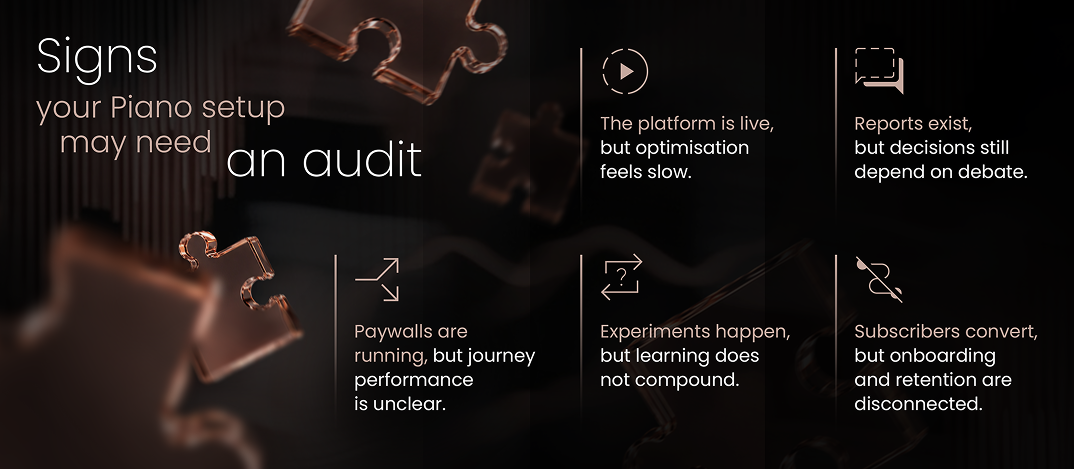
A publisher should consider a Piano audit when the platform is live but performance, confidence, or operational clarity is weaker than expected.
Common signs include:
The most important sign is not one bad metric. It is a lack of confidence.
If the team cannot clearly explain how Piano is supporting reader revenue growth, where the biggest journey friction sits, and what should be improved next, the setup is ready for an audit.
Start with the subscription journey, not the platform configuration.
The wrong way to start a Piano audit is to open the platform and immediately inspect every configuration detail.
That work matters, but it should not come first.
The first step is to map the actual subscription journey from the reader’s point of view. This helps the team see where Piano is supporting the journey, where it is creating friction, and where the setup no longer matches the publisher’s commercial goals.
A useful journey review should include six areas.
1. Article experience
For many publishers, the subscription journey begins on the article page.
This is where readers first experience the value of the product. It is also where they encounter prompts, registration messages, newsletter asks, subscription cues, and paywall triggers.
A Piano audit should ask:
If the article experience does not prepare the reader for the ask, the paywall has to do too much work.
2. Registration
Registration is often treated as a technical step. Readers experience it as an exchange.
They are being asked to give time, attention, and personal data. If the value of that exchange is unclear, registration becomes friction.
A Piano audit should review:
This is especially important because registration can support more than one goal. It can help with first-party data, engagement, identity, propensity modelling, and future subscription conversion. But it only works if the journey makes sense to the reader.
3. Paywall and offer logic
A paywall audit should not only ask whether the wall converts.
It should ask whether the right readers are seeing the right ask at the right time.
Key questions include:
Dynamic paywalls and audience segmentation can be powerful, but only when the underlying strategy is clear. If the basic logic is weak, dynamic rules can scale confusion rather than solve it.
This is why a Piano implementation audit should look at both configuration and commercial reasoning.
4. Checkout and entitlement flow
Checkout is where interest becomes commitment.
Small points of friction matter here. Confusing price presentation, limited payment options, unnecessary account steps, poor mobile experience, entitlement issues, or unclear confirmation messages can all weaken performance.
A Piano audit should check:
This is not just a UX issue. It affects revenue quality, customer satisfaction, support burden, and early subscriber confidence.
5. Onboarding and retention
A subscription journey does not end when payment is completed.
For publishers, the first moments after conversion are commercially important. This is when the subscriber should understand what they now have access to, what to do next, and how to get value quickly.
A Piano audit should ask:
6. Reporting and experimentation
Reporting is where many Piano setups quietly lose momentum.
The issue is not always that data is missing. More often, the problem is that the reporting model does not create enough confidence for decision-making.
A Piano audit should review:
The goal is not more dashboards. The goal is decision-ready reporting.
If teams cannot trust experiment results, compare journeys, or understand where users drop off, optimisation becomes slower and more political than it needs to be.
A practical Piano audit for publishers should cover five areas.
| Audit area | What to check | Why it matters |
|
Journey logic |
How users move from article to registration, paywall, offer, checkout, and onboarding |
Shows where friction appears before conversion |
|
Commercial setup |
Paywall rules, offer structure, pricing logic, audience segmentation |
Reveals whether Piano supports the subscription strategy |
|
UX and messaging |
Value proposition, prompts, registration copy, offer clarity, confirmation messages |
Shows whether users understand why to act |
|
Experimentation |
Test structure, success metrics, readouts, learning process |
Shows whether optimisation is disciplined or ad hoc |
|
Reporting |
Data definitions, dashboards, ownership, KPI confidence |
Shows whether teams can make reliable decisions |
This framework keeps the audit focused. It prevents the work from becoming either too technical or too vague.
A weak Piano setup is not always broken.
In fact, that is what makes it difficult to spot. The system may be live, but not commercially sharp.
|
A weak Piano setup |
A stronger Piano setup |
|
Paywall is live |
Paywall is connected to audience and offer strategy |
|
Registration exists |
Registration has a clear value exchange |
|
Offers can be launched |
Offer architecture is easy to test and govern |
|
Experiments happen occasionally |
Testing follows a clear learning roadmap |
|
Reports are available |
Reporting is trusted and decision-ready |
|
Subscribers convert |
Subscribers are onboarded and activated |
|
Teams can make changes |
Teams can improve the setup without creating fragility |
This distinction matters because many publishers do not need a full rebuild. They need to identify where the current setup is limiting performance and where targeted optimisation would create the most leverage.
If a publisher is not sure where to begin, the audit should start with the areas most likely to affect subscription performance.
1. Check whether the journey is coherent
The first question is whether the reader journey makes sense.
Does the path from article to registration to subscription feel connected? Or does each step feel like it belongs to a different team?
A coherent journey should have clear progression:
If that progression is missing, paywall optimisation alone will have limited impact.
2. Check whether value is introduced early enough
Many publisher journeys introduce the subscription value proposition too late.
If the first serious explanation of value appears at the paywall, the message has to work very hard. It is trying to explain the product, justify the price, reduce hesitation, and drive action all at once.
A stronger journey builds value earlier through:
A Piano audit should identify where value is currently introduced and whether that timing is strong enough.
3. Check whether registration helps or hurts the journey
Registration can be valuable, but only if it is designed with care.
If it appears too early, too abruptly, or without a clear benefit, it can suppress momentum. If it appears at the right moment with a clear exchange, it can support identity, engagement, data quality, and future conversion.
A good audit should ask:
Registration should not be just a gate. It should be part of a relationship-building strategy.
4. Check whether experiments are producing useful learning
Testing is only useful if the team can understand what changed and why it mattered.
A Piano audit should review whether experiments have:
A test that improves click-through but weakens subscriber quality may not be a win. A test that increases starts but creates higher churn risk may need a more careful reading.
The point of experimentation is not activity. It is learning that compounds.
5. Check whether reporting is trusted
Reporting is often the difference between a setup that improves and a setup that stalls.
If teams do not trust the numbers, optimisation slows down. Product, subscription, editorial, CRM, and commercial teams can all end up looking at different versions of performance.
A Piano audit should check whether everyone agrees on:
Without this, the business may have data but not clarity.

The output of a Piano audit should not be a long list of disconnected issues.
It should produce a prioritised roadmap.
A useful roadmap should separate findings into three groups:
1. Fix now
These are issues that create immediate friction or measurement risk.
Examples include:
2. Optimise next
These are areas where the setup works but could perform better.
Examples include:
3. Build over time
These are larger improvements that require more planning.
Examples include:
This structure helps teams move from audit to action. It also avoids the common problem of identifying too many issues without deciding what matters most.
A Piano audit should not be treated as a generic website review. Publisher subscription systems have their own logic. A strong audit needs to understand editorial value, reader behaviour, subscription economics, product constraints, commercial pressure, and the operational reality of publisher teams.
A publisher does not need a cleaner Piano setup for its own sake. It needs a setup that makes the subscription business easier to improve.
It needs a setup that makes the subscription business easier to improve.
That means:
A Piano implementation audit is often the best starting point when a publisher already has Piano live but cannot clearly see where performance is being lost.
The purpose of a Piano audit is not to produce a document.
The purpose is to create clarity.
Where is the journey leaking value? Where is the setup too hard to change? Where are users being asked to act without enough context? Where are experiments failing to produce learning? Where is reporting creating debate instead of decisions?
Those are the questions that matter.
For publishers, Piano can be more than a paywall or registration tool. It can be core subscription infrastructure. But only if the setup is aligned with the way readers actually move, decide, subscribe, engage, and stay.
That is why the best place to start is not the platform screen.
It is the journey.
Not sure where your Piano setup is losing value? Optiten can help you audit the journey, identify friction, and prioritise the changes most likely to improve subscription performance.
Request a subscription journey audit
Request your audit