Why publisher subscription journeys fail before users reach the paywall
2026-06-098 min read
2026-06-098 min read

Why publisher subscription journeys fail before users reach the Paywall
The paywall gets blamed for a lot.
When conversion is weak, offers underperform, or subscription growth stalls, the instinct is often to look at the paywall first. Is the messaging wrong? Is the offer too weak? Is the wall too aggressive? Is the model wrong?
Sometimes the answer is yes. But just as often, the paywall is only where the problem becomes visible.
For publisher teams, subscription journeys usually break earlier. They break when a user reaches the conversion moment without enough context, without enough value explanation, or after a journey that has already created unnecessary friction.
That matters because it changes what teams should fix.
If you work on publisher subscription journeys, this is one of the most useful mindset shifts to make: stop treating the paywall as a standalone conversion mechanism, and start treating it as one step within a wider subscription system.
A paywall is a highly visible moment in the journey. It is easy to point at, easy to test, and easy to debate internally.
But visibility is not the same as cause.
In many publisher journeys, the paywall is doing too much work because too little has happened before it. The user has not been given a clear enough sense of why the content is worth supporting, what the subscription offers, or why the next step makes sense now. By the time the paywall appears, the system is asking the final conversion moment to compensate for everything the journey failed to establish earlier.
So the better question is not only, “Is the paywall good enough?” It is, “What has the journey done before the paywall appears?”
For publishers, a subscription journey usually begins well before a user sees a paywall.
It starts with:
When those elements are weak, the paywall has to absorb too much pressure.
A user might reach the ask:
In that situation, the paywall is not the beginning of the problem. It is the point where the weakness finally becomes measurable.
This is exactly why a subscription audit for publishers is often more useful than jumping straight into paywall tweaks. If the upstream system is weak, paywall-only optimisation tends to produce shallow gains.
1. Weak value explanation
A lot of publisher journeys assume the value of subscribing is already obvious.
Sometimes it is. Often it is not.
If a user reaches the conversion moment without enough clarity on what they are paying for, the journey is already under strain. This is especially true in crowded subscription markets, where users do not only compare prices; they compare relevance, trust, habit value, and whether the proposition feels worth acting on now.
This is one reason article pages matter so much. They are not just content surfaces. They are often where editorial value and commercial value first meet.
2. Unclear article-to-offer progression
Many publisher journeys break in the transition between reading and acting.
A user can be engaged with the article and still not feel pulled into a coherent subscription path. The reason is often not one broken component, but poor progression:
This is where Piano implementation and optimisation for publishers becomes less about setup and more about journey design. The strongest journeys create momentum. Weaker ones create interruption.
3. Registration that feels like friction
Registration is one of the most misunderstood moments in the subscription journey.
Publisher teams often treat it as a technical or operational step. Users experience it differently. They experience it as a request: give us your data, your time, or your commitment. If the journey has not explained why that exchange is worth making, registration feels like friction instead of progress.
Publishers vary enormously in how they explain that exchange and guide the user into the next step.
4. Messaging that arrives too late
One of the biggest structural mistakes in subscription journeys is introducing the “why subscribe” message too late.
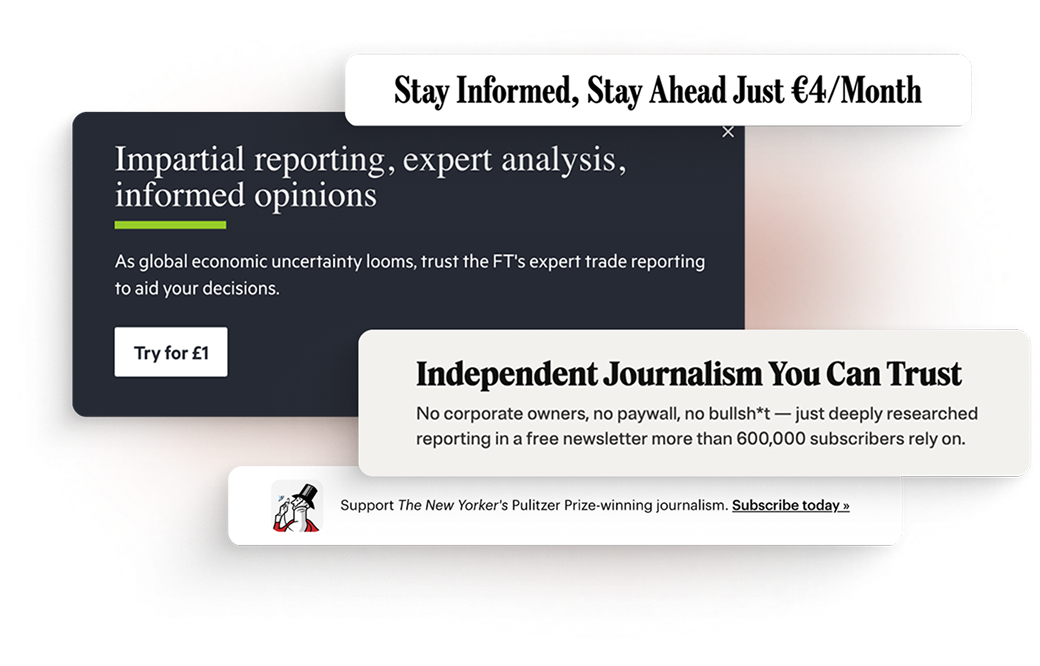
If mission, value, or reader-support messaging only appears at the paywall, it often feels opportunistic. The same message, introduced earlier through article pages, navigation cues, support framing, or offer context, can do much more work.
This is one of the core ideas behind our comparative analysis of publisher messaging and journeys: placement changes meaning. A value message introduced earlier helps build context. The same message delivered at the final moment is forced into the role of justification. See how leading publishers place mission, value, and brand messaging across subscription journeys?
5. Onboarding treated as separate from conversion
A lot of teams still separate onboarding from conversion too sharply.
But in publisher reality, they are part of the same commercial system. If a journey creates subscribers but fails to orient, engage, and reassure them quickly afterward, the conversion quality was weaker than it looked.
| What gets blamed | Where the issue often begins |
| Paywall conversion | weak value framing |
| registration drop-off | unclear exchange |
| low subscriber quality | poor onboarding logic |
| weak paywall response | bad article-to-offer progression |
This is not just a UX issue. It is a strategic one.
The subscription environment has matured. Publishers are operating in a market where:
Straightforward subscriber growth is no longer enough, and media companies need to sharpen their focus on churn, engagement, and lifetime value.
In that environment, publishers cannot afford to see the paywall as a standalone fix.
The strongest publisher journeys usually do three things better.
They build value before the ask
They do not wait until the paywall to explain why the relationship matters.
They treat journeys as systems
They connect the article experience, prompts, registration, offers, and onboarding rather than treating each as a separate workstream.
They optimise beyond conversion
They look at whether a journey is creating the right kind of subscriber experience, not just the immediate conversion event.
If a publisher suspects the journey is breaking before the paywall, the first step is not to rewrite one line of paywall copy and hope for the best.
Start by auditing:
This is where a subscription audit for publishers can be genuinely useful. It gives teams a way to see whether the problem is really the paywall — or whether the paywall is only surfacing upstream weaknesses in the journey.
Publisher subscription journeys usually do not break at one dramatic moment.
They break through weak progression, missing context, unclear value exchange, and too much friction before the final ask even appears. The paywall is often where the problem becomes visible, but not where it began.
That is why stronger subscription performance usually comes from looking at the whole system: the article page, the message, the registration step, the offer, the onboarding path, and the way those parts connect.
Request a subscription journey audit
Request your audit